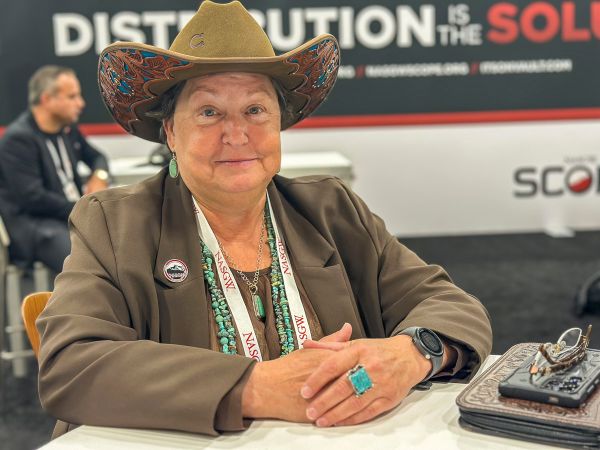
During this week’s NASGW Expo in Phoenix, Arizona, I sat down with Shaylene Keiner, president of the executive search firm HeadHunters NW. We met Tuesday morning in the NASGW SCOPE Lounge on the show floor to discuss the current state of hiring in the firearms industry.
Most people don’t realize it, but show season—and SHOT Show in particular—is a busy time for those looking to hire and those looking to get hired. After a number of conversations with Shaylene over the last couple of years, it’s become pretty clear that she has her finger on the pulse of the firearms industry job market.
QA Outdoors How would you describe the current market for executive and senior-level talent in the firearms industry? Are companies competing for a limited pool of proven people, or is there more qualified talent available than employers realize?
Shaylene Keiner While it stays the same, it does change. You can find a lot of talent, but it might not be precisely the talent you need. Our industry needs very specific talent for very specific problems. It varies based on the size of the company and the challenges it's facing.
Like every other industry, we're going through a big change with aging. We have a lot of people aging out. New people are coming in, and there seems to be a gap in between. In employers' minds, those people don't have enough experience.
One of the things we should do—which is hard because it's scary—is give those people a chance to come into senior-level roles, even if they may not have accomplished everything on that massive list. We've got to grow the talent.
QA Outdoors What positions are currently the most difficult for firearms companies to fill, and what makes recruiting for those roles particularly challenging?
Shaylene Keiner What comes to mind right away is engineers—optical engineers specifically. They're super tough to find because there are so few.
A lot of HR generalists find out very quickly that engineers are not just one kind of engineer. They might specialize in accessories, metals or the way a vacuum works. Firearms engineers could even be narrowed down to pistols and rifles. There are so many different niches inside that niche that it's very hard to find people.
You have very few people, and you almost always want them to be at your location. Now you're talking about relocating them, cost of living and people's families. Then you have to take the economy into account. I would say, hands down, engineers, for a myriad of reasons.
QA Outdoors How important is previous firearms industry experience when evaluating a candidate? When does that experience become essential, and when might a company benefit from hiring someone from outside the industry?
Shaylene Keiner We need to do more of that. I think we can vet people to fit into our industry, and I'm not sure it's good enough for someone to say, “I'm comfortable with that product.” That's where we may fall down in hiring. There does need to be a real passion, but I don't think successful candidates have to come from our industry for every job.
As a matter of fact, it's really important that we hire a certain number of people who are not from our industry because we tend to recycle the same ideas. New people, new types of people, are really important to the future of our industry.
QA Outdoors Firearms companies often say they want someone who understands the culture. What does cultural fit actually mean, and how can a company evaluate it without simply hiring people who think and operate exactly like its existing leadership?
Shaylene Keiner That's a tough one. HR departments all over the United States, and probably the world, fight that every day. Every company's culture is different. It's made up of the leaders and the people who are there.
As an industry, if I were to describe our culture, we're accepting of people who enjoy the outdoors, have respect for the outdoors and have respect for our freedoms. We're good about keeping that culture. We're not very good about modifying it at times, and that's something we should be looking at all the time. We can retain our history but also evolve our culture.
QA Outdoors Before beginning a search, what questions should owners ask themselves to determine what they truly need from a new executive, rather than building a job description around an idealized candidate who may not exist?
Shaylene Keiner That might be my favorite question. I don't even know what the other ones are, but that could be a whole article in itself.
Here's why: Companies come with a job description, and what they really need is to know what goals they want to achieve in the next three, six and nine months, and beyond that—a year, two years or five years from now.
They need to go back and rewrite that description and define what accomplishments they want these people to complete. A job description is not the way we achieve the next level of where we want to take companies. I know we use that in our culture, but what we really should be talking about is the excitement of where we're going.
Where are we heading? Where does the company want to go? Where is this position headed? What could this person achieve in an ideal situation? That's what we should really be focusing on.
Companies don't often put together measurable 30-, 60- and 90-day goals: Here's what you're going to accomplish. That's how we know you're going to succeed.
QA Outdoors How often do you find that a company's stated requirements for a position differ from the problems it actually needs the new hire to solve?
Shaylene Keiner I think that happens often, but that's normal. The best companies are willing to evolve and reevaluate as they go through their hiring process because the process very often brings up burrs underneath the saddle, if you will. Just by going through it, you learn things.
The best companies are flexible and modify what they need as they go through the process, but they don't change the goal. That has to be consistent. You can't go into a recruitment and change what you're looking for halfway through. There's a big difference there.
QA Outdoors What warning signs tell you a company is not prepared to bring in the executive it says it wants, particularly someone expected to change strategy, professionalize operations or challenge ownership?
Shaylene Keiner I think that happens accidentally more often than intentionally. You can't give someone the responsibility without the authority. A lot of times, the authority is kept close to the chest, and they can't be responsible if they don't have the authority to make those changes.
QA Outdoors Are you able to spot that early when a company comes to you for help hiring an executive? Or is it harder to discern that ownership isn't really going to give the new executive free rein?
Shaylene Keiner Yes, it can be spotted early, as long as you have a process where you say, “Let's get the 30-, 60- and 90-day goals in order,” and go through very specific, achievable goals.
You say, “This is what you want them to accomplish. When are they going to accomplish it by, and how are they going to accomplish it?” If your leadership, the board or whomever is not willing to turn over those reins, it's very hard for that leader to be successful.
Those discussions need to happen early. Otherwise, the executive you're putting in place doesn't stand a chance to succeed.
QA Outdoors Not all new hires work out. When a key hire fails, how often is the individual genuinely the wrong person, and how often did ownership fail to provide clear expectations, adequate authority and internal support?
Shaylene Keiner That's a tough one. It varies with companies. I'm not sure I could put a number or percentage on it.
The more vetting and planning you do up front—the job description, the goals, really laying out why and how this person is going to succeed—the more successful your hire will be. Without that work up front, it's a crapshoot.
QA Outdoors Have you placed people you knew were a good fit who ended up failing, but you understood they were still the right person? The company or culture wasn't right, or ownership simply wasn't willing to let go?
Shaylene Keiner I'm not sure I could answer that directly. I would say that a good recruiting firm is going to have a guarantee period. The reason you have a guarantee period is because you're selling a two-sided coin. You're working with a person who has an opinion and significant others. You're dealing with humans, and humans aren't perfect.
A guarantee period is very important to put skin in the game because there are times when a good hire fails for reasons outside everyone's control. There could be an emergency in a family.
Life happens.
I'm not sure you're ever going to get away from some failed hires, no matter how much vetting you do, but it should be very, very rare.
QA Outdoors Founder-led firearms companies can struggle when they begin adding professional management. What mistakes do founders commonly make when handing responsibility off to an experienced outside executive?
Shaylene Keiner That's hard for any business owner. You've put your heart and soul into it. It's hard to hand off any responsibility. The challenge for owners building these wonderful companies is finding someone they trust, and sometimes that takes meeting a lot of people.
QA Outdoors Is there a typical point at which owners realize a new hire is not working out, and what should they examine before deciding that replacing the individual is the correct solution?
Shaylene Keiner I'm not sure how I could answer that, except that preparation ahead of time is what keeps the guardrails on. All the work up front—going through the expectations, setting the guidelines and giving authority along with responsibility—should keep you within the rails.
Replacement for any position is very expensive. It's not just a recruiting fee. It's damage to the culture and time lost. More preparation up front hopefully keeps that from happening.
QA Outdoors What responsibility does a candidate have to investigate the company, its leadership and its culture before accepting a position, and what questions should that candidate be asking during the interview process?
Shaylene Keiner I think that's somewhat generational in some ways, but it's on anyone to do their homework ahead of time. We have so many tools available that you should be able to do your research and prepare.
If you're working with a recruiter, that recruiter should have a lot of detail. They should be able to help you navigate each step, each interview.
Depending on whether it's a local job, a relocation or a hybrid role, there's a lot of homework that needs to go into it. What's the community like? What's the travel going to cost? Who's going to pay for that? There's a lot of homework to be done with any new job.
QA Outdoors Let me pivot to hybrid work. How much of your recruiting involves on-site, hybrid or remote positions? Where do we stand on the demand for remote work?
Shaylene Keiner I'm really glad you asked this because it's a common question. Without the perspective of being in this every day, like I am, it's hard to see.
There are a lot of companies running with remote employees only. If they're not manufacturing a product, I think you can do that with the right people in place, but you've got to have very good systems and people who are held accountable.
For instance, I'm working on a controller position right now, an accounting role. At first, the hiring manager only wanted someone local. But because of where the headquarters is, the odds of finding someone who's pro-firearms and pro-2A in that area are very low. They're reconsidering hybrid, which I think is very smart because you get a wider choice of talent.
With remote work, you have more choices, so your odds of getting the best talent for the money are much higher.
When you need talent locally—for instance, engineers—it can be very hard to design things if you need to be right there with your team. Other roles need to be there, too: operations and manufacturing.
I think you can absolutely build that, but you have to think about where you're located. If your headquarters is in a small town in, let's say, the South, with very few people, it's really hard to recruit because you just don't have the numbers. It depends on what leadership is willing to invest in it.
QA Outdoors Once a company finds the right person, what matters most in keeping that individual? Is it compensation, autonomy, advancement opportunities, alignment with the mission or the relationship with ownership?
Shaylene Keiner One of the best customers I work with—the one most successful at hiring—offers unlimited PTO for salaried people, with the hiring manager's approval. They're flexible with work hours. They have remote employees for some jobs and on-site employees for others. For those on-site, they offer a four-day workweek.
There's flexibility so people can live. They're not demanding every second of that person's time. They also don't underpay. They review their benefits and try to be very competitive. All of those things make people stay. Those employers don't have employees calling me to get them out of there.
The employers cutting corners, pinching pennies and demanding butts in seats or a high level of accountability without utilizing the IT tools and software we have to monitor work and check in regularly—without overseeing and micromanaging people—are the ones whose employees are looking for work.
QA Outdoors Let me finish with this. What advice would you give younger, mid-level professionals who want to position themselves for a senior leadership role or eventually the C-suite?
Shaylene Keiner I might surprise you with this answer. One thing I don't see these young professionals doing is getting involved with the executives who are at the senior level now.
A great place to do that, and a great way to rub elbows, is the NSSF PAC. They have a PAC meeting at most of our trade shows. These young professionals can contribute a minimum amount, even if they can't afford the maximum, and go in and be in a room with executives who have the power to hire them.
There are other networking events, and they should also utilize LinkedIn. Don't be afraid to reach out to people more senior than you and have conversations with them. Offer to meet for coffee or lunch because those people have great advice on how to help you get to the next level.
QA Outdoors Thank you very much for your time, Shaylene. I appreciate your time this morning.